
Nexus Universe · LSPD
Standard Operating Procedures

Administrative Policies
& Standard Operating Procedures
Current As Of: AUG 2026
PD SOP HANDBOOK
Los Santos Police Department
THE MISSION
OUR MISSION IS TO PROVIDE NEW AVENUES OF RP FOR ONGOING SITUATIONS
- You will uphold the law with authority and presence — without killing roleplay.
- You will create fear through professionalism, not pettiness.
- You will respect the line between IC and OOC; don't punish players, punish characters.
- Prioritize RP over mechanical wins or content farming.
- Read the room, contribute to scenes, and carry yourself like a person — not a bot. Zero tolerance for Low Quality RP.
- Superiors will challenge you — expect structure, feedback, and some pressure.
- You are expected to act with integrity, both IC and OOC.
- Cops are not allowed to shoot at any cost you have to verbally de-escallate the situation.
- Transferring of PD Item to crims and civillian will be considered under corruption.
We reserve the right to remove you IC or OOC, at any time, if you're not upholding our values.
WELCOME TO LAW ENFORCEMENT
OATH OF HONOR
This is your first step towards becoming a law enforcement officer. We hope you thrive in your career in law enforcement and wear the badge with pride and integrity.
Upon graduating the academy, you'll take an oath marking you as one of San Andreas' finest — words you'll be expected to honor for life.
"On my honor, I swear to serve with integrity and uphold the law without bias or compromise. I will carry this badge with courage, hold myself and others accountable and protect the trust of the people. I will stand for justice, act with honor and never forget who I serve."
Welcome to Law Enforcement in San Andreas
THE BIBLE
CORE VALUES
- RP First: Don't salt mine for content. Provide quality interactions.
- Good Faith > Fast Arrests: Choose RP over mechanics.
- Chain of Command: Follow it. Always.
- Removal Can Be IC or OOC Without Warning.
- Tough in RP but have good sportsmanship on an OOC level.
LEGAL BURDENS
| Action | Required Standard |
|---|---|
| Frisk | Reasonable Suspicion |
| Search / Arrest | Probable Cause |
| Cell Charge | Preponderance or Higher |
| Trial Conviction | Beyond Reasonable Doubt |
USE OF FORCE
| Level | Type | Description |
|---|---|---|
| 1 | Presence | Be present, identify, show yourself |
| 2 | Verbal | Conversation, influence, issue orders |
| 3 | Empty Hand | Tackle in chase → Punch when Punched |
| 4 | Less Lethal | Taser with unarmed suspect |
| 5 | Lethal | Only with Good Faith Belief per Tennessee v. Garner |
Do not needlessly escalate. Rule of thumb: show force +1 of what you're met with. Violence is a last resort.
RADIO & COMMS
- Accuracy: What you know, not what you think.
- Brevity: Don't ramble.
- Clarity: Speak steady & clear. Don't yell.
- Say "Break" for emergencies only.
- Use plain speak unless using radio codes.
FOOT PURSUITS
- Use cardinals (N, E, S, W)
- Never blindly corner
- Radio:
"Sex / Hair / Top / Bottom / Direction / Street" - No shooting tires.
PURSUITS
- Max 4 vehicles, +1 per interference vehicle (Max 6). Command can override.
- After 2nd vehicle involvement or command approval → grappler can be deployed; PITs prohibited; one vehicle allowed to deploy grappler.
- 1st tails, 2nd Comms, 3rd + 4th Parallels.
- Only primary tails through tight corridors like alleyways.
- Spikes must be called clearly and in advance.
- Use cardinals (N, E, S, W) for comms.
- 2x 80's rotate on main comm channel. 2+ move tac.
THE BIBLE — FIELD PROCEDURES
PROCESSING
- Search/GSR on Scene, Search in Cells.
- Call lawyer ASAP → PC hearing straight to court.
- If you cuff, you own the suspect's processing.
- Only fingerprint/DNA at station, hospital or courthouse.
- Weapons license only removed for violent felonies.
FORENSICS
- Collect all forensics at any violent scene and upload to investigation report.
- Casings = where shot from.
- DNA = pools of blood;
- Upload via MDT > Evidence tab.
BREACH & CLEAR
- Announce yourself as Police with warnings.
- Cut the pie method, avoid crossing firing lines, clear sectors.
- Clear each corner, comm each clear.
- Detain suspects (even civilians), cover detainment before moving forward.
- Secure suspects in vessel out of harm's way before continuing.
- Clear each sector until complete. ID each suspect, release any cleared detainees.
TRAFFIC STOPS
- Primary: Left side, trunk tap, ID, reason, plate.
- Felony Stop: Triangle formation, order occupants out one-by-one.
- Secondary: Cover, assist with radio/comms.
THE BIBLE — SPECIAL SITUATIONS
VIOLENT CALL POLICY
- Highest rank calls rally point (3–4 blocks out).
- 8 units max.
- Highest rank handles unit count, recon, briefing.
- All officers assigned roles.
- De-escalate first → shoot if warnings ignored or shots fired.
LOOTING SUSPECTS
Warn looters. After 2 warnings:
- Armed = Lethal Force
- Unarmed = Tackle / Taze
REMOVING MEDICALS
- ID Affiliations.
- If not allied, warn they'll be shot.
- State: Removal = threat to victim.
- Fleeing with body = engage.
PITs, BLOCKS AND SPIKES
- PIT: Prohibited.
- No PITs by interceptors, trucks, or on parked cars.
- Spikes & Blocks:
- Announce.
- Spikes are only authorized either by command approval or after the 2nd Vehicle involvement is made.
- Only when safe.
- Blocks let chase pass before moving.
EXIGENT CIRCUMSTANCES
Entry without warrant is permitted when:
- Imminent destruction of evidence
- Person in danger
- For a Warrant holder
- Fleeing Suspect (Hot Pursuit)
- Plain View Doctrine
GOOD FAITH BELIEF
A Good Faith Belief is backed by the combination of evidence, intuition and training that a violent action is about to occur.
Use Good Faith Belief to decide that de-escalation has failed and there is a likelihood that serious injury or death could occur.
PD STANDARDS
CULTURE — LEGAL FOCUS
Use critical thinking to understand your actions and their impact on others. You must know when, why, and how to:
- Frisk another person
- Search another person
- Charge another person
Each charge requires a burden of proof. As PD, you must understand and clearly explain how that burden was met.
Levels of Legal Burden
CLOCK IN
ON DUTY
- Clock on duty by holding Alt key at the front desk of MRPD.
- In the event of a game crash, clock on using
/dutypolice. - Join the radio (Use radio from inventory → Join Channel 2).
OFF DUTY
- Place your ENTIRE loadout in your locker.
- Clock off at a police station by holding Alt key at the front desk of MRPD.
CAREER PROGRESSION
| Call Sign | Rank |
|---|---|
| 1XX | Commissioner |
| 1XX | Deputy Commissioner / Colonel SASP |
| 1XX | Chief LSPD / Sheriff BCSO |
| 2XX | Assistant Chief / Undersheriff |
| 2XX | Deputy Chief / Chief Deputy |
| 3XX | Commander |
| 4XX | Captain / Trooper Captain |
| 5XX | Lieutenant / Trooper Lieutenant |
| 6XX | Head Sergeant / Trooper Sergeant |
| 6XX | Sergeant |
| 7XX | Corporal |
| 8XX | Senior Officer / Senior Deputy |
| 8XX | Officer First Class / Deputy First Class |
| 8XXX | Officer / Deputy / Trooper |
| 9XXX | Probationary Officer / Probationary Deputy |
| 9XXX | Cadet |
CHAIN OF COMMAND
The chain of command is a core thread of police roleplay.
- Follow the chain of Command.
- Only skip the chain to raise concerns afterwards.
EXPLANATION / EXPECTATIONS OF RANKS
| Rank | Responsibility |
|---|---|
| Commissioner / Deputy Commissioner / Colonel | Ultimate authorities over their respective LEO departments, SOPs, department operations, and LEO employment status. |
| Chief LSPD / Sheriff BCSO | Highest departmental authority responsible for overall department leadership, operations, standards, and personnel. |
| Assistant Chief / Undersheriff | Senior department leadership that supports the Chief/Sheriff and assists in overseeing overall department operations and command staff. |
| Deputy Chief / Chief Deputy | Senior command staff responsible for assisting department leadership, overseeing divisions, personnel, and day-to-day department operations. |
| Commander | Oversees certifications, FTO programs, departmental programs, and supervises command-level operations. |
| Captain / Trooper Captain | Senior command officer responsible for leading major departmental operations and overseeing assigned shifts, divisions, or units. |
| Lieutenant / Trooper Lieutenant | Supervisory command rank responsible for internal programs, FTO, certifications, and assisting with the management of officers and field operations. |
| Head Sergeant / Trooper Sergeant | Senior field supervisor responsible for assisting command staff, supervising Sergeants and officers, maintaining operational standards, and overseeing field operations. |
| Sergeant | Field leader and primary supervisor; first point of contact for officers, responsible for discipline, oversight, and day-to-day field operations. |
| Corporal | Entry-level NCO and field leader; assists Sergeants with supervision and represents the first formal step in the Chain of Command. |
| Senior Officer / Senior Deputy | Experienced LEO with strong knowledge of procedures, SOPs, and field operations; expected to assist and guide junior officers. |
| Officer First Class / Deputy First Class | Experienced full-duty LEO who has demonstrated consistent performance and knowledge of departmental procedures. |
| Officer / Deputy / Trooper | Full-duty LEO expected to understand, follow, and enforce all departmental SOPs and procedures while performing regular field duties. |
| Probationary Officer / Probationary Deputy | Newly appointed LEO completing their probationary period and gaining experience under departmental standards and supervision. |
| Cadet | Entry-level LEO focused on learning departmental procedures, SOPs, communication, and basic field operations before progressing to a full-duty position. |
FIELD TRAINING INSTRUCTOR (FTI) — POWERS AND AUTHORITY
Authority over Non-Command and Non-HC Officers
- An FTI may send any Non-Command and Non-High Command (HC) officer for retraining based on the severity of the situation.
- The FTI must notify the senior-most authority in the department (e.g., Chief, Sheriff) regarding the action taken.
Authority over Command Members
- An FTI may send a Command-level officer for retraining only after mutual agreement with both High Command (HC) and the senior-most authority of the department (e.g., Chief, Sheriff).
Authority over High Command Members
- An FTI may send a High Command officer for retraining only after mutual agreement with the senior-most authority in the department (e.g., Chief, Sheriff).
Additional Powers
- Department Heads (Chief or Sheriff): FTI may recommend retraining only after mutual agreement with the Commissioner's Office.
- Appoint FTOs: An FTI has the authority to select Field Training Officers after consulting with the department head.
- Terminate Cadets: FTI must consult and receive approval from the department head before terminating a Cadet.
PROMOTIONS, DISCIPLINE & LOA
PROMOTIONS
Promotions are earned through consistent performance, initiative and professionalism. Those who lead by example, close cases, follow SOPs, and improve the department will move up.
NCO and Command ranks come with OOC responsibilities as well as IC duties.
DISCIPLINARY ACTION
All disciplinary action is recorded:
- A SHOT (Subordination, Honor, Off-duty Conduct, Training) is issued (Command or higher).
- Can be a warning with coaching, monetary penalty or accumulating SHOT point(s).
- SHOT Points:
- 3 shots = auto 24 hour suspension with command review for further punishment.
- Point expires 30 days from issuance.
This is an at will state — we can fire for any reason at any time.
LEAVE OF ABSENCE
- Submit LOAs on the web roaster.
- You do not need to contact command unless it is OVER 7 days (4 days for probies).
- You may still be terminated if you were inactive prior to submission.
POWERS DISTRIBUTION
NCO Authority
- Coaching and Guidance
- Verbal Warning
- Written Warning
- Recommend of Suspension
Update all actions taken in a command disciplinary action report. COC needs to be followed while taking any action or dealing any complaint.
Warning Expiry:
- 15 days — verbal warning
- 30 days — written warning
Command Authority
Command includes everything NCO has, plus:
- Authority to issue SHOTs.
- Recommend for retraining to FTI/High Command.
- Recommend for Certificate Suspension or removal to individual Department Heads.
- Commands are not allowed to send anyone off duty, demote, suspend or terminate — but can use other forms of punishment (e.g., desk duty).
High Command Authority
High Command can take actions for all of the above and make decisions wherever needed in department and sub-department.
All SHOTs can be challenged by reaching out to the Commissioner's Office.
LOADOUT & EQUIPMENT
While on duty, you must have the following (these limits are minimums and maximums):
| Item | Qty | Item | Qty |
|---|---|---|---|
| Combat Pistol | 1 | Stun Gun | 1 |
| Weapon Nightstick | 1 | Flashlight | 1 |
| Ammo-9MM | 3 | Cuff | 1 |
| Armor Plates | 5 | Heavy Armour | 2 |
| Bandage | 10 | Evidence Kit | 1 |
| Repair Kit | 3 | Government Radio | 1 |
| Aircraft Repair Kit | 1 | Camera | 1 |
| Parachute | 1 | PD Compass | 1 |
| Oxycodone | 5 | Tourniquet | 5 |
| Quickclot | 5 | Spikes | 1 |
You must store ALL PD gear when going off duty. Duty pistols for duty only.
Special Equipment Regulations
(Limited to 1 and held in lockbox until needed)
Spike Box:
- Only deploy during an active scene.
- Carry only one (box or strips).
- Must be in sight (no spiking civilians).
Failure to follow loadout requirements will result in disciplinary action.
SERVICE VEHICLES
Fleet/Vehicle Requirements
- Repair and refuel vehicles before storing.
- Keep your vehicle clean, roadworthy and fully repaired while in service.
- You must lock your car when leaving at all times.
- Unmarked cars are not allowed.
- Car Customizations:
- Only minor, tasteful customizations allowed.
- Do not change paint color — liveries must remain visible.
Patrol Vehicle Classes
| PATROL (D Class) | PATROL (C Class) | PATROL (B Class) |
|---|---|---|
| ALEUTIAN | MINIMUS | SENTINAL |
| TERMINUS | CARACARA | BATI |
| RIATA | PANTO |
VIOLENT CALL POLICY — STRATEGIC RESPONSE PROCESS
Violent calls (gang shootouts, tactical encounters, clustered shooting calls) activate this policy.
- Highest ranked unit should call for a rally point 3–4 blocks from the scenario to assess the situation.
- 8 officers should be called to the rally point.
- As officers arrive, the highest ranked unit should recon and assess the situation.
- Officers should be counted by the highest ranked unit to ensure limits are enforced.
- Highest ranked unit should ensure strategic plan is briefed to all officers and they're given assignments.
- Officers should attempt to de-escalate shooters. If warnings are ignored or shots are fired at officers, officers may use lethal force when efforts fail or officer lives are in immediate danger.
Looting Suspects
- Verbally warn suspects looting.
- If armed, warn they may be met with lethal force.
- If unarmed, warn they will be tackled or tased.
- After two ignored warnings, escalate with appropriate force.
Removing Medicals
- Identify affiliation of those removing downed persons.
- If not allied, warn they may be shot if they take the body.
- State clearly: removal poses risk of further harm to the victim.
- If they flee with the body, you may engage under good faith belief of continued threat.
One Sided Aggressor
When only one side is aggressive or refuses de-escalation:
- Communicate to the non-aggressors that police will fire on the opposing side.
- Once confirmed, open fire on the aggressors.
- If non-aggressors continue shooting — they must also be opened fire upon.
99'S — OFFICER DOWN
When Downed — Decision Tree
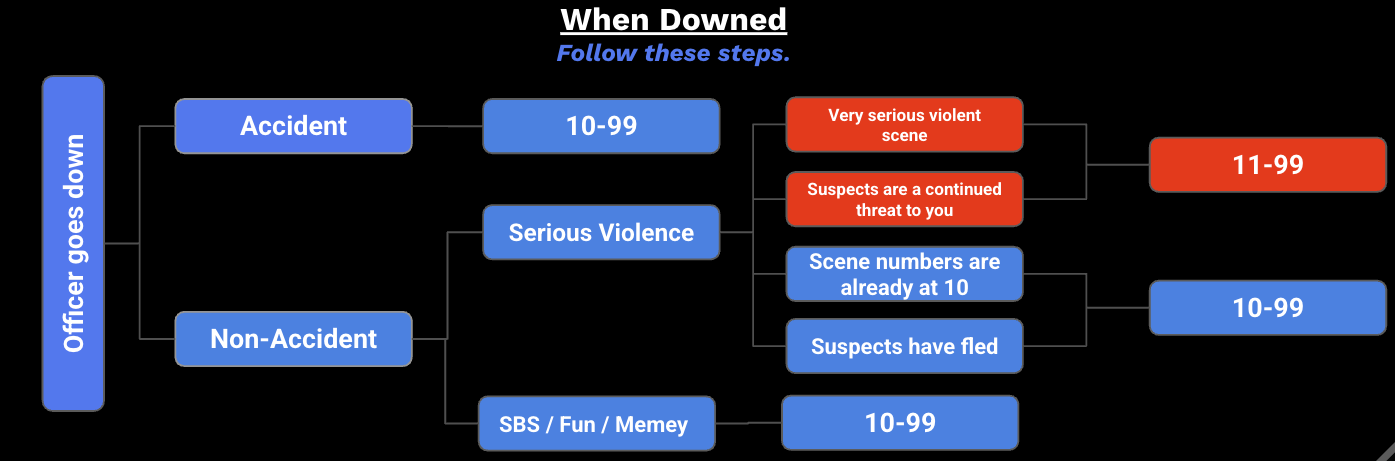 Officer Down Decision Tree
Before Calling 11-99
- Has the scene played out (read the room)? If no, hold.
- Are you at maximum units? If yes, call 10-99.
- Would the 11-99 negatively impact the scene? If so, don't.
- Scene won't benefit from the 11-99? If so, don't.
11-99 Response
- Assess if call is legitimate.
- Follow Violent Call Policy.
- Match number of additional officers to a total of 8 on scene.
- Prioritize rescue of officer over engaging in combat.
PURSUITS PROCEDURE
Unit Limits
- 4 units max per pursuit.
- +1 per interference vehicle per pursuit (up to 6 total units, max).
- Command can override.
- Units can rotate out if damage or low on fuel.
- Use discretion when multiple chases converge — reassess units needed per target.
- 1 AIR-1 & 1 pursuit vehicle or 2 MOTO per chase.
Chase Start and Roles
| Role | Code | Description |
|---|---|---|
| Primary | Code 3 | Leads pursuit — "Callsign, Active 80, Dir/Street, Color, Type, # Occupants" |
| Secondary | Code 2 | 4-car gap, takes comms |
| Tertiary + | Code 2 | Runs parallel / spikes / blocking |
GRAPPLER & Swaps
- DO NOT USE GRAPPLER over 80 MPH.
- Grappler can only be installed at PD Locations,installing anywhere else will be considered as powergaming.
- GRAPPLER authorized when:
- 2 Vehicles Involved.
- Commanding Officer Approval.
Spikes and Blocks
- Announce clearly: location of block or spikes, including which lane.
- Do not spike stationary vehicles.
- Stay with spikes until removed.
- Blocking units stay still until pursuit passes.
- Only block when safe to do so.
NON-STANDARD PURSUITS
Rolling Shootouts
- Assess and identify shooters.
- Warn: "If you continue shooting, you will be met with lethal force."
- Engage if they cease to stop or pose a threat.
- Exit vehicle before shooting if suspect goes on foot.
- If fired on from a vehicle, you may return fire from a vehicle.
Boat Chase
- In the water type
/giveboat— comm on radio. To remove:/delboat. - If suspects jump into the water:
- After warnings you may open hand strike.
- If armed (knife), follow use of force protocols.
AIR-1 (Helicopter)
- Limit of 1 helicopter per pursuit.
- Limit of 2 helicopters in air at once.
- Helicopters must not high hover to act as a satellite.
- Helicopter must have co-pilot who does comms.
Transborder (Cayo)
- We can only enforce the law in San Andreas.
- We cannot make arrests in Cayo Perico.
- Cayo's waters start at the naturally occurring storm waters.
LAWYER & PD STANDARDS
Expectations of LEOs
Officers are expected to:
- Offer a lawyer ASAP to their suspect.
- Be able to articulate verbally the burdens of proof for any charges listed.
- Act in good faith with negotiation with lawyers.
Expectations of Lawyers
- Act professionally utilizing proper manners and not cursing/insulting officers in the cells.
- Respect police officers' time and boundaries as well as suspects in custody.
- Lawyers must not speak with any suspects they were not called to represent.
- If lawyers present themselves as a risk to PD operations, temporary detention is allowed.
LEO Holding Area Policy
- Any officer can expel a lawyer if they have deemed them in violation of the expectations set in our SOPs.
- If a judge or bar association rep is available, attempt to utilize them to mediate.
- This does not constitute a violation of their client's rights — their client can still plead not guilty.
- Officer must make every effort to find new counsel for the suspect.
- Officer should ensure the lawyer's conduct was extreme and they made every attempt to warn, de-escalate and work with the lawyer before expulsion.
- Detentions of lawyers who are a risk must be temporary and the operation must be expedited. If cell phone is seized, it must only be to prevent information leak and cannot be searched.
PRISONER TRANSPORTATION
Prisoners may request a prison transport during processing after an arrest. As an officer you are obliged to organize a transport for the suspect IF POSSIBLE. Prison Transport is only authorized by High Command.
Procedures
- Organize your officers (Max of 8).
- Scene lead designates a radio frequency and a route from MRPD to Bolingbroke Penitentiary.
- Once organized, begin the transport.
- The Transport must remain at 55 mph.
- If Attacked, form a defensive position to protect the bus in a safe area.
- Do not rush to the prison or enter the prison if attacked.
- Once it is safe, process your suspects inside the prison.
RADIO COMMS
The ABCs of Communication
| ACCURACY | BREVITY | CLARITY |
|---|---|---|
| THINK before transmitting | Keep your transmission BRIEF | Speak slowly and CLEARLY |
OFFICERS MUST DISPLAY GOOD RADIO ETIQUETTE AT ALL TIMES
Comms Policy
- Don't talk over people on radio unless it is the highest priority (extreme endangerment of life).
- You can clear the radio by saying "Break" and sending the relevant traffic.
- If you need another officer urgently, use the "Hey you, it's me" format:
- Format: "899, 100 direct"
- If not urgent, call them to keep radio traffic clear.
- Small talk is not tolerated during active situations.
- If you are huddled inside a police station, at least ONE officer must have a radio turned on.
- If you are in a PD car you must have your radio on at least 20%.
ROBBERIES
Primary (Scene Lead — First Unit on Scene)
- States number of individuals on scene, weapons, clothing and location of any suspected escape vehicles over radio.
- State if any hostages are being held on scene.
- Initiate contact with the individuals and begin negotiations when safe to do so.
- Have units block roads and stage vehicles to pursue.
- Designate pursuit order and which unit will receive the hostage.
Additional Units
- Observe the scene, assist in negotiations if asked by scene lead and secure the hostage if requested.
- Obtain Identification, a statement and check the hostage to make sure they didn't get any illegal items planted on them.
CALL PROCEDURES & PRIORITY
| CRITICAL | HIGH | LOW |
|---|---|---|
| 11-99 | Felony Stops | Store shoplifter |
| Mass Casualties (Violent) | Property Robberies | Drug Sales |
| HVT Warrants | 911 Reports | Robberies |
| Command Prioritized Calls | Pursuits | Traffic Violations |
| Prison Break | Weapons at Court | Motor Vehicle Accidents |
| Business Robberies | Street Races | 10-99 |
| Warrant Execution | Store Alarm | Shots Fired Calls |
| Medical (no EMS) | Mass Casualties (Non-Violent) |
Scene Control
First unit on scene is the scene lead. They are responsible for the scene, making sure SOPs are followed. They direct other officers to do the necessary tasks, including calling for Medical support, arranging triage points, and appointing negotiators. They also make a decision on escalation of force.
- Everyone on a crime scene should be detained, questioned + identified.
- If a firearm was involved, test everyone for GSR (gunshot residue).
- Terry v. Ohio covers frisking for weaponry with reasonable suspicion.
- United States v. Carroll & Wyoming v. Houghton cover searching vehicles.
ARREST & PROCESSING
Arrest Steps
- Give treatment to any injuries sustained.
- Confiscate weapons and contraband used in the commission of the crime.
- Remove the batteries or take the phone and Radio.
- GSR Test (if the situation involved guns).
- Transport to the hospital.
- If ICU — Cuff to bed and Write a Warrant (if HVT, process at Bolingbroke ICU).
- Mirandize and Offer suspect a PC hearing to contest the legality of the arrest.
- Process at MRPD or Cells depending on PC hearing.
Processing Steps
- Update Mugshot.
- Take Fingerprint.
- Move to the cells and secondary search them.
- Call Lawyer if requested.
- Create/add suspect to a report.
- Add appropriate charges.
- Negotiate with lawyer (if applicable).
- Receive the suspect's plea and sentence them.
Important Notes
- You CANNOT Fingerprint a suspect until you have transported them back to a police station OR Courthouse.
- The ONLY time you remove a weapons license is when they commit a violent felony.
ARRESTS AND PROCESSING — PROBABLE CAUSE HEARING
To provide a fair, structured opportunity to determine if sufficient evidence exists for formal charges, conducted in a courtroom setting upon request, bypassing detention at MRPD.
The Process
- Bring Suspects to the Courthouse via the underground parking.
- Bring them to the holding cells and fingerprint them.
- Follow directions from the justice on how to proceed with the hearing.
- IF SUSPECTS ARE BROKEN OUT: Create a note on their profile that they are banned for a month from PC hearings and note the date.
PC Hearing Flowchart
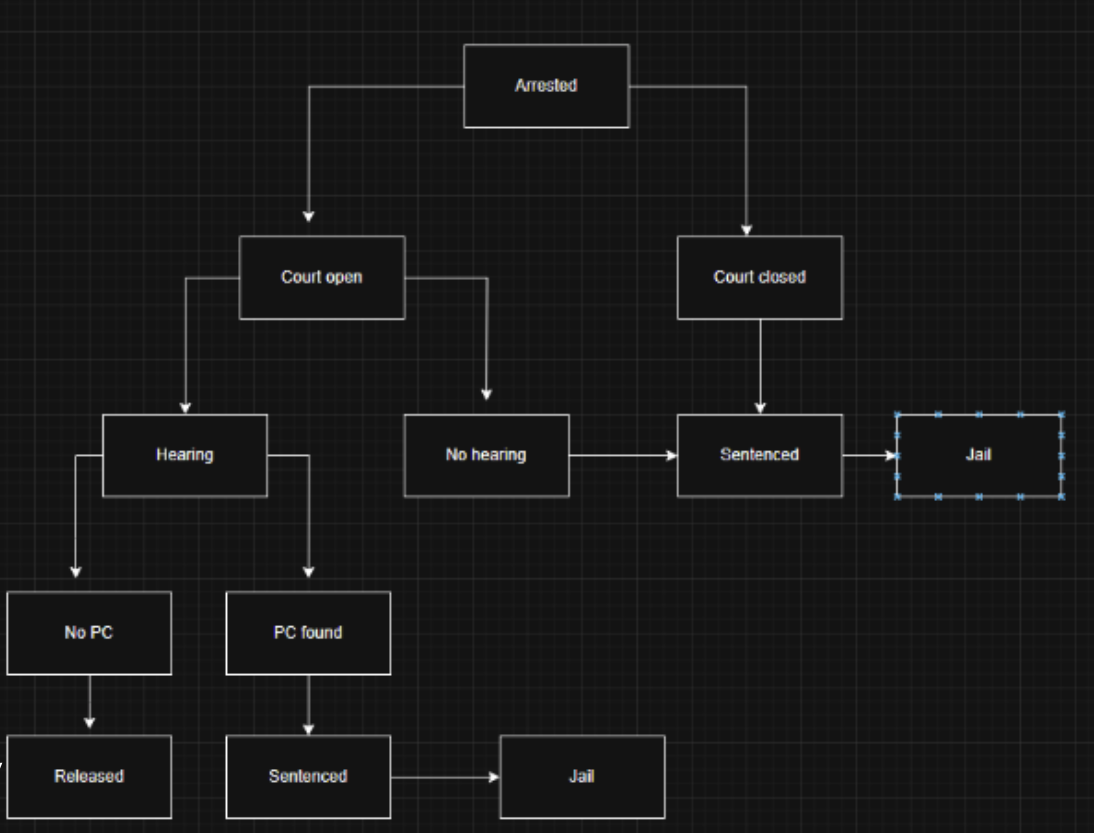 PC Hearing Flowchart
LEGAL THEORY & ARRESTS
USE OF FORCE
Peace officers must recognize that they have the authority to use reasonable force to effect an arrest, to prevent escape, or to overcome resistance as authorized by the Penal Code. It is critical that peace officers know the laws governing the use of force.
The 5 Levels of Force
| Level | Type | Description |
|---|---|---|
| 1 | Officer Presence | No force is used. The mere presence of a law enforcement officer works to deter crime or diffuse a situation. Officers' attitudes are professional and nonthreatening. |
| 2 | Verbal Commands | Force is not physical. Officers issue calm, nonthreatening commands. May increase volume and shorten commands. Short commands: "Stop" or "Don't Move." |
| 3 | Empty Hand Control | Officers use bodily force to gain control. Soft: grabs, holds, joint locks. Hard: punches and kicks. |
| 4 | Less Than Lethal | Officers use less-lethal technologies. Blunt impact (baton/projectile) or TASER to immobilize a combative person. |
| 5 | Lethal | Officers use lethal weapons. Only if a suspect poses an immediate threat to an Officer or another individual. A significant threat must be present. Individuals fleeing with weapons alone is NOT enough. |
Learning Objectives
Tennessee v. Garner: A police officer may use deadly force to prevent the escape of a fleeing suspect only if the officer has a good-faith belief that the suspect poses a significant threat of death or serious physical injury to the officer or others. Suspects must be warned, while shouting within range, at least once unless the life of the officer or others is in immediate danger.
You should always attempt to defuse a situation by using your voice. If your voice is not working, you may move to tackle or then taser. The appropriate escalation of force needed for a situation is based on the situation at hand. Every scenario is different — study your peers carefully. It takes time to learn.
GOOD FAITH BELIEF
Definition: A Good Faith Belief for Tennessee v. Garner is a bona fide belief which is backed by the combination of evidence, intuition and training that a violent action is about to occur.
In San Andreas, we use Good Faith Belief to decide that de-escalation has failed and there is a likelihood that serious injury or death could happen to an officer, a citizen or a subject themselves.
Examples
Fleeing in the company of violent felons:
- Isn't enough for a good-faith belief of a significant threat.
- However, fleeing with violent felons and making no attempt to exit their company does mean that law enforcement are not liable for accidental or coincidental shootings.
Fleeing unarmed:
- There is NO GOOD FAITH BELIEF and there is no precedent protecting law enforcement.
- Use non-lethal force.
Fleeing with gun in hand:
- Non-violent suspect: NO GOOD FAITH BELIEF — don't shoot.
- Violent threats or has already shot: Good Faith Belief — you may use lethal force when safe.
PROBABLE CAUSE VS REASONABLE SUSPICION
PROBABLE CAUSE
Probable cause is the good faith belief that a crime has, is, or will take place based on facts, circumstances and officer training/experience.
Probable cause is based on facts or actual evidence and is enough for a search or arrest warrant.
REASONABLE SUSPICION
Reasonable suspicion is the reasonable belief that a crime has, is, or will take place based on facts, circumstances and officer training/experience.
Cannot search or arrest.
TRAFFIC STOPS
Primary Unit
- Dispatch the stop: Location, number of occupants & the description/plate of the vehicle.
- Exit your vehicle and begin the stop.
- Do not walk in front of your vehicle (kill zone).
- Once at the C pillar of the vehicle, make sure the backseat is clear.
- If back seats are empty, move to the B Pillar and start speaking to the driver.
- State your rank, name and department. Tell the driver the reason you stopped them and ask for their ID and registration.
Car Pillar Locations
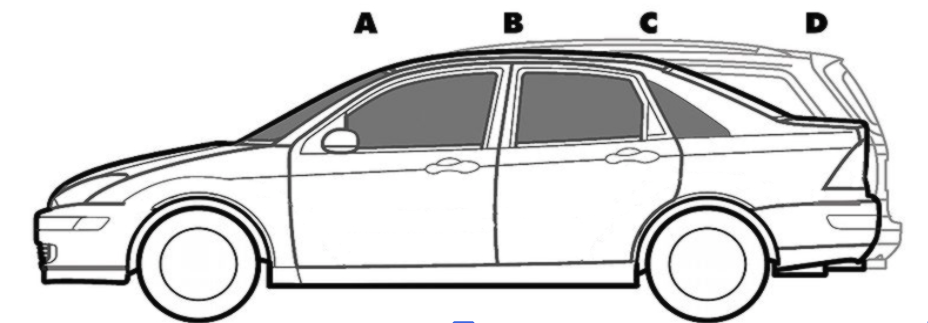 Car Pillar Locations
Safe Cruiser Position
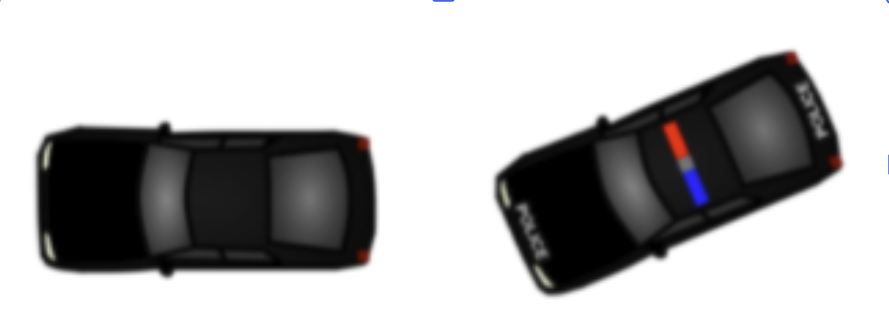 Safe Cruiser Position
Additional Units
- Assist in controlling the stop, processing names or plates, or staging for pursuit.
FELONY STOPS
Felony stops happen when a crime is being committed, you have reasonable suspicion that a crime might be committed, or the vehicle owner has an active warrant.
Setup Process
PRIMARY | CONTACT Place vehicle behind the suspect vehicle and radio:
"Callsign — Conducting Felony Traffic at LOCATION. Other units set?"
SECONDARY | COVER Place vehicle next to PRIMARY at an angle. When PRIMARY asks if set, radio:
"Callsign — Set"
TERTIARY | COVER Place vehicle behind both PRIMARY and SECONDARY. When PRIMARY asks if set, radio:
"Callsign — Set"
Felony Stop Formation
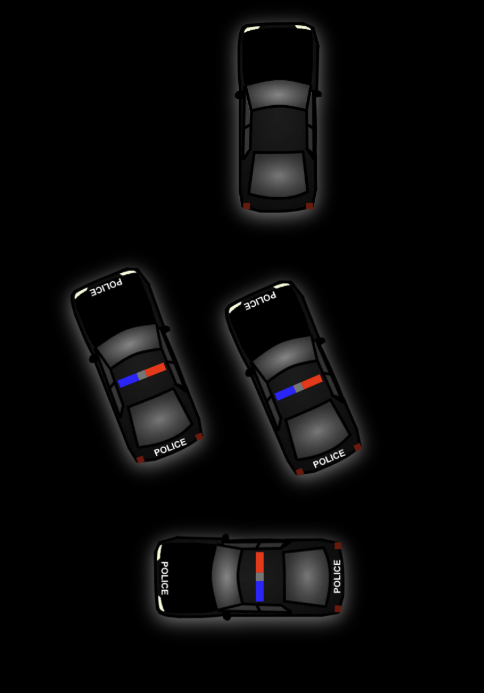 Felony Stop Formation
Step by Step
- Order everyone in the vehicle to keep their hands up.
- Order the driver to toss the keys out of the driver side window.
- Order the driver out of the vehicle, facing away from you.
- Instruct them to walk backwards to the sound of your voice. Do not direct them into traffic.
- Follow this process for everyone inside.
- Once detained, two officers should clear the vehicle from back to front, clearing all pillars on each side before moving to the trunk.
- Once secure, let dispatch know the suspect(s) are in custody and the scene is Code 4.
NEGOTIATIONS PROCESS
The 5 Steps to Negotiations
| Step | Stage | Description |
|---|---|---|
| 1 | Active Listening | Listen to them and make them aware you're listening. |
| 2 | Empathy | You get an understanding of where they're coming from and how they feel. |
| 3 | Rapport | Empathy is what you feel; Rapport is when they feel it back. They start to trust you. |
| 4 | Influence | Now that they trust you, you've earned the right to problem solve with them and recommend a course of action. |
| 5 | Behavioral Change | They act. You respond. |
6 FBI Hostage Negotiation Techniques
- Ask Open Ended Questions — You don't want yes/no answers. You want them to open up.
- Effect Pauses — Pausing is powerful. Use it for emphasis, to encourage people to keep talking, or to defuse things when people get emotional.
- Minimal Encouragers — Brief statements to let the person know that you are listening and to keep talking.
- Mirroring — Repeating the last word or phrase the person said to show that you're listening and engaged.
- Paraphrasing — Repeating what the other person is saying back to them but in your own words. This shows them that you really are listening.
- Emotional Labeling — Give their feelings a name. It shows you're identifying with how they feel. Don't comment on the validity of the feelings — just show that you understand.
HOSTAGE NEGOTIATIONS
There are times where a hostage may be involved in scenes. Although this can be intimidating, it is important that you remain calm, focused and clear at all times.
Your priority during a hostage situation is to make sure that the hostage(s) are passed onto officers safely and unharmed.
If a hostage is on scene ensure the following:
- Radio that there is a hostage on scene.
- When making contact, establish what the terms are.
- If this is something we can consider, radio this information to other officers on scene.
- Try and prevent any weapons aimed at the hostages or Officers.
- We DO NOT negotiate hostages for a request of money, Police equipment OR police vehicles. These are unreasonable demands.
- DO NOT allow hostages to be taken out of sight.
- When received by an officer on scene, all hostages must be identified, offered medical attention, and asked if they consent to a search and give a statement.
PURSUITS — DETAILED COMMS
Pursuit Comms Format
Use Cardinal directions and Landmarks to keep comms concise. Start radio traffic with:
"Callsign — Active 10-80 / Direction of travel / Street Name / Color of vehicle / Type of vehicle / # of occupants"
Unit Roles
PRIMARY — LIGHTS & SIRENS Code 3
Location is given first to help additional units:
"Dispatch, 100, show me in an active 80, westbound Vespucci Boulevard, blue in color 4 door sedan, occupied 4 times"
SECONDARY — LIGHTS Code 2
Secondary follows 5 car lengths back and typically takes over comms:
"500, taking secondary & comms, continuing West Vespucci"
TERTIARY — LIGHTS Code 2
Pursue via parallel routes in an attempt to get ahead of the pursuit in order to lay spikes or block lanes of travel.
Blocking
When blocking you should REMAIN STATIONARY until the entire pursuit has passed you. DO NOT try and move to hit the fleeing vehicle.
"809 — Blocking right lane, correct lanes of travel"
Spike Strips
Use clear communication before laying spike strips. Do not lay them if you don't have enough time to communicate. STAY WITH THE SPIKES UNTIL THEY ARE ROLLED BACK UP.
"840 — Spike deployed, right side lane, correct lanes of travel"
Pedestrians
If a pedestrian or other occupied vehicle is struck during a pursuit, a unit must stop to perform a safety check and call for medical aid.
Interference Vehicles
If you encounter an interference vehicle, identify if they are actively interfering and follow use of force protocols during the 10-80.
Alleys
When a pursuit drives through an alleyway, only the primary vehicle should follow. Secondary and parallels should go around to avoid blocking the primary from an escape if necessary.
FOOT PURSUITS
Foot Pursuit Comms
Give a brief description of the fleeing suspects using this pattern:
Sex / Distinguishing Feature / Top Color / Bottom Color / Direction / Street or Landmark
"Dispatch, 100, in an active foot pursuit, 1 Female, Blue Hair, White on Black, Currently north bound Strawberry"
Foot Pursuit Procedure
- Identify the correct use of force:
- If someone is running with a gun — have your service pistol in hand.
- If they are unarmed — use less than lethal options like Tasing & Tackling.
- When navigating urban terrain NEVER blindly follow suspects around corners.
- Use cardinals. NORTH, EAST, SOUTH & WEST.
BREACH & CLEAR
If negotiations fail, if responding units believe the hostage would be safer making a move than not, or if there is no hostage at a bank/Vangelico/bank truck/Bobcat — then breaching is an option.
Breach Considerations
- If there are more suspects than Officers, DO NOT breach.
- Multiple warnings should be given:
"This is your final warning. If you do not all come out with your hands up we will be forced to come into the bank. Any retaliation may be met with lethal force."
- Inform dispatch to request medical units to stage:
"Dispatch, Alpha-395, can I have a medical unit stage nearby Vespucci Bank for a possible breach?"
- Stack up on the doors and breach, SLICING THE PIE as each officer enters the premises.
- Negotiate for hurt officers/people within the bank if officers become severely outnumbered.
Slicing the Pie Method
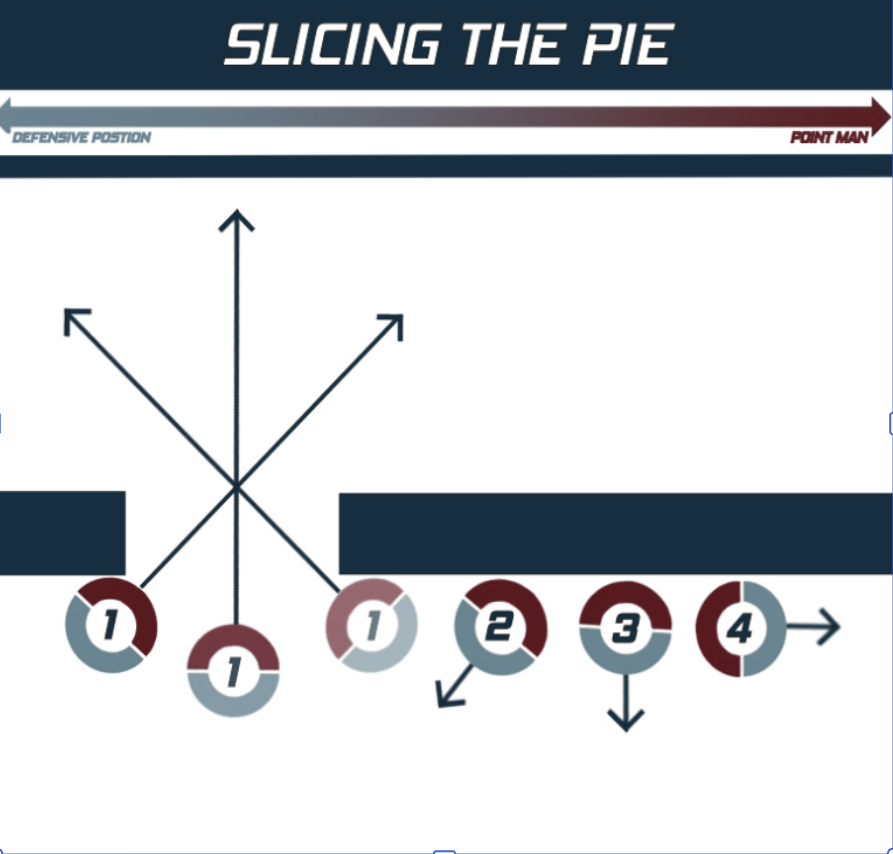 Slicing the Pie
MEDICAL AID & MASS CASUALTIES
Call Priority
- If medical staff are on duty and available, Officers are not required to attend the scene of medicals unless instructed by Medical staff or shift command due to suspicious circumstances (GSWs, stabbings, etc.).
- If medical staff are not available, officers will be expected to attend the scene of all medicals as their highest priority and provide life saving care to any injured individuals.
Providing Medical Aid to Suspects
- Handcuff the suspect before you stabilize.
- ID the suspects and perform a pat down, removing all weapons.
- Suspects remain handcuffed unless receiving medical attention.
- While receiving medical attention, handcuff them to the bed.
- Keep eyes on your suspect at all times until they are medically cleared.
- If admitted to ICU or overnight observation — keep them cuffed to the bed. (If HVT — transport to prison ICU.) Ask local doctors to contact the police line when the suspect is ready to be charged.
- Issue a warrant for the charges at this time.
Mass Casualties
- Ensure the threat is stopped before rendering aid.
- Secure the scene. If a scene of a shooting, detain all individuals on scene (including injured parties via handcuffs).
- Cordon off the area and request EMS personnel.
- Check vitals and render appropriate aid until EMS can arrive.
- Officers who have placed individuals in handcuffs MUST follow EMS to the hospital.
- Officers without suspects will remain on scene and process evidence.
WARRANTS & SUBPOENAS
Warrants
For warrants, you need to make sure the burden of proof has been met for each charge, including naming any/all victims of the crime committed and filing the evidence as needed.
TIP: Remember, you cannot have a victimless crime.
Write up a short narrative with a timeline indicating how the Burden was met.
Subpoenas & Search Warrants
- Create an MDT investigation.
- Attach the DAO.
- If you need approval from command or the district attorneys, add them as well.
- Fill in details, attach evidence.
Exigent Circumstance
You do not need a warrant to enter a building to search for someone if there are exigent circumstances:
- In 'hot pursuit' of a felon and you see them enter the building.
- To render emergency aid to an occupant.
- To enter a burning building.
See Missouri v. McNeely.
Los Santos Police Department · PD SOP Handbook All officers are expected to know, understand and follow these procedures.